37 Trades, 12 Markets, and a Plan to Stay in Control
“I'm not trying to turn my life around on one call. I want to never need luck to sit through one.”
 AiXFundedAiXFunded Official Team
 5 min read
 5 views

Contents
For five years, he worked in risk control at a brokerage, watching what happened when other people’s positions went wrong. That experience stayed with him when he began trading his own account. Even when he felt confident about a market, he struggled with the idea of letting one position dominate his exposure.
Still, knowing the risk did not mean he always avoided it.
Across two evaluation attempts, he passed once and failed once. The failed attempt ended with his exposure concentrated in a single market. News hit, a sharp candle followed, and the evaluation was over.
After that, he stopped concentrating his positions.
“I'm not trying to turn my life around on one call. I want to never need luck to sit through one.”
Reading the Rules First
He first came across AiXFunded in a group chat. Before entering, he looked at how the evaluation worked: how drawdown was calculated, whether limits reset daily, and what conditions could end an attempt.
His background had made those details important to him. A trading approach had to fit the account’s rules, including what could happen while positions were still open. Once he felt comfortable with those conditions, he decided to try.
The earlier failure gave him a specific problem to address. He wanted to avoid a situation in which one unexpected move could decide the outcome of the entire account.
Building the Positions
On the evening of the 22nd, between 9:40 and 9:50, he began opening positions one by one.
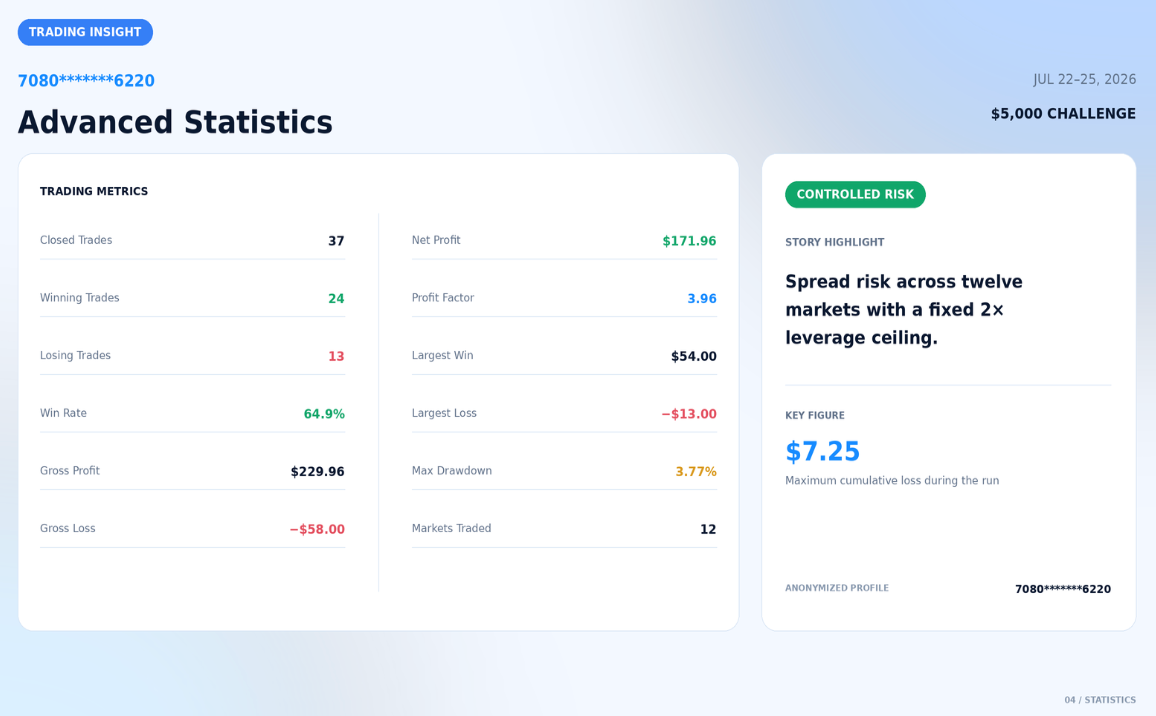
The markets included Bitcoin, Ethereum, SOL, XRP, ADA, AAVE, INJ, NEAR, and SUI, alongside several tokenized US equities. Across the three-day run, he would open 37 positions in 12 markets.
When someone asked whether he was simply scattering orders around, his answer was straightforward: he was spreading his exposure.
Most positions used between $100 and $600 in margin, while the two largest used slightly more than $1,200 each. The allocations were not equal, but every position used the same leverage: 2×.
He chose that level with the whole portfolio in mind. With multiple positions running together, he was concerned about what would happen if several moved against him at once. At higher leverage, a handful of losing trades could create a much larger account-level problem.
“Two is a number I calculated, not one I picked,” he explained.
Holding 12 markets did not remove the possibility of shared losses, particularly among crypto assets that could move together. His approach combined that broader spread of positions with a deliberate limit on leverage.
A Quiet Trading Session
Asked whether there had been a tense moment during those three days, he said there had not.
The next day, people in the group were discussing another drop in Bitcoin. His phone, he recalled, had not sent him a single alert. For him, that uneventful experience was part of the reason for trading this way.
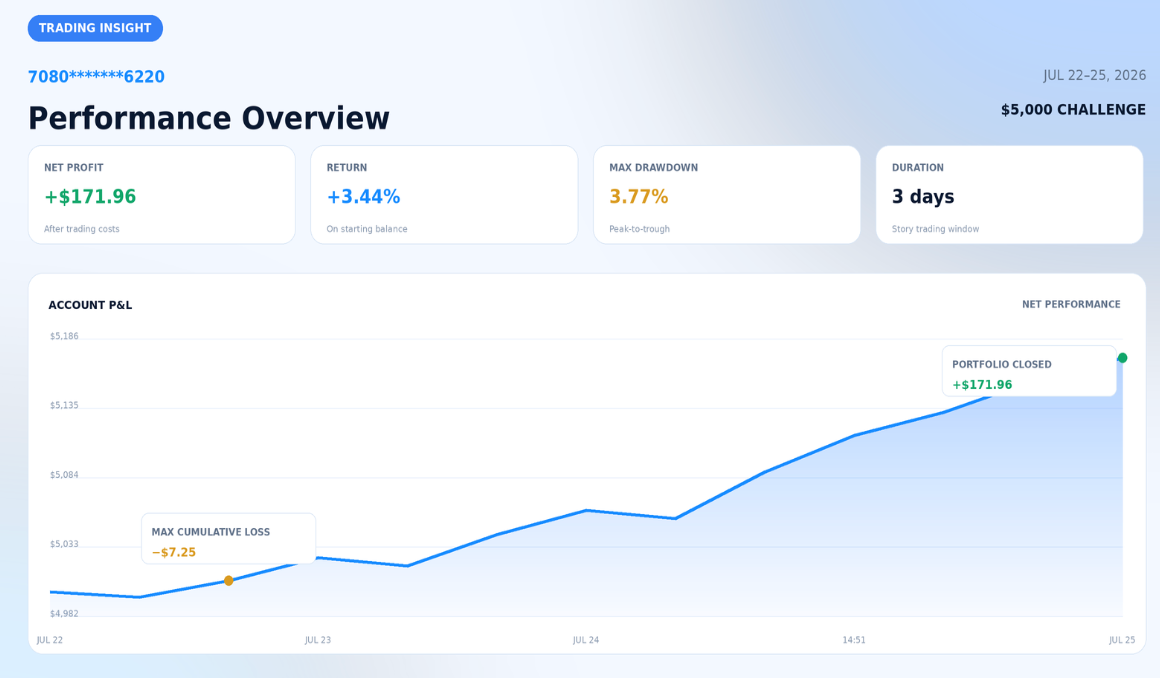
The run still included losses. Of the 37 trades, 13 finished negative, with combined losses of approximately $58. The largest individual loss was around $13. The other 24 trades produced approximately $230 in combined gains, with the best trade contributing about $54.
He finished the three days with roughly $171 in net profit. The reported peak-to-trough drawdown was 3.77%.
These were the results of a short trading window, but they illustrated what he had been trying to change after his failed attempt: the account’s outcome came from a series of trades, with individual setbacks absorbed along the way.
An Exit Written Down the Night Before
Opening the positions was only part of his plan. He had also decided when to close them.
At 2:51 the following afternoon, he closed most of the book, working through the positions within roughly a minute. The timing had been written down the previous evening.
That detail mattered to him because he saw hesitation as a weakness in his own approach. Once positions were profitable, it would be easy to keep watching, hoping for a little more, and repeatedly postpone the exit.
A scheduled close gave him a decision to follow when that moment arrived. He did not need to work out a new plan while looking at the changing profit on his screen.
He later reported receiving his payout in around 17 hours, with the funds arriving the next day.
No Trade to Win Back the Last One
He understood that $171 from 37 trades would not sound dramatic. Spread across the run, it amounted to less than $5 per position.
“I won't argue with anyone about it — this approach doesn't make money quickly,” he said.
There was another detail he cared more about: none of those 37 positions, he explained, had been opened to recover the loss from the previous one.
His earlier failure had already shown him how quickly concentrated exposure could end an attempt. He did not want the next loss to become a reason to abandon his sizing, increase leverage, or force another trade.
That gave the story its most consistent thread. He checked the rules before entering, spread his positions across markets, kept leverage at 2×, and followed an exit time decided in advance. When a trade lost money, he wanted the next decision to remain independent of the urge to make it back.
The lesson he would pass on to someone starting out was simple: work out how much you can lose before deciding how much you want to make.