Down 16%, my finger was on the close all button
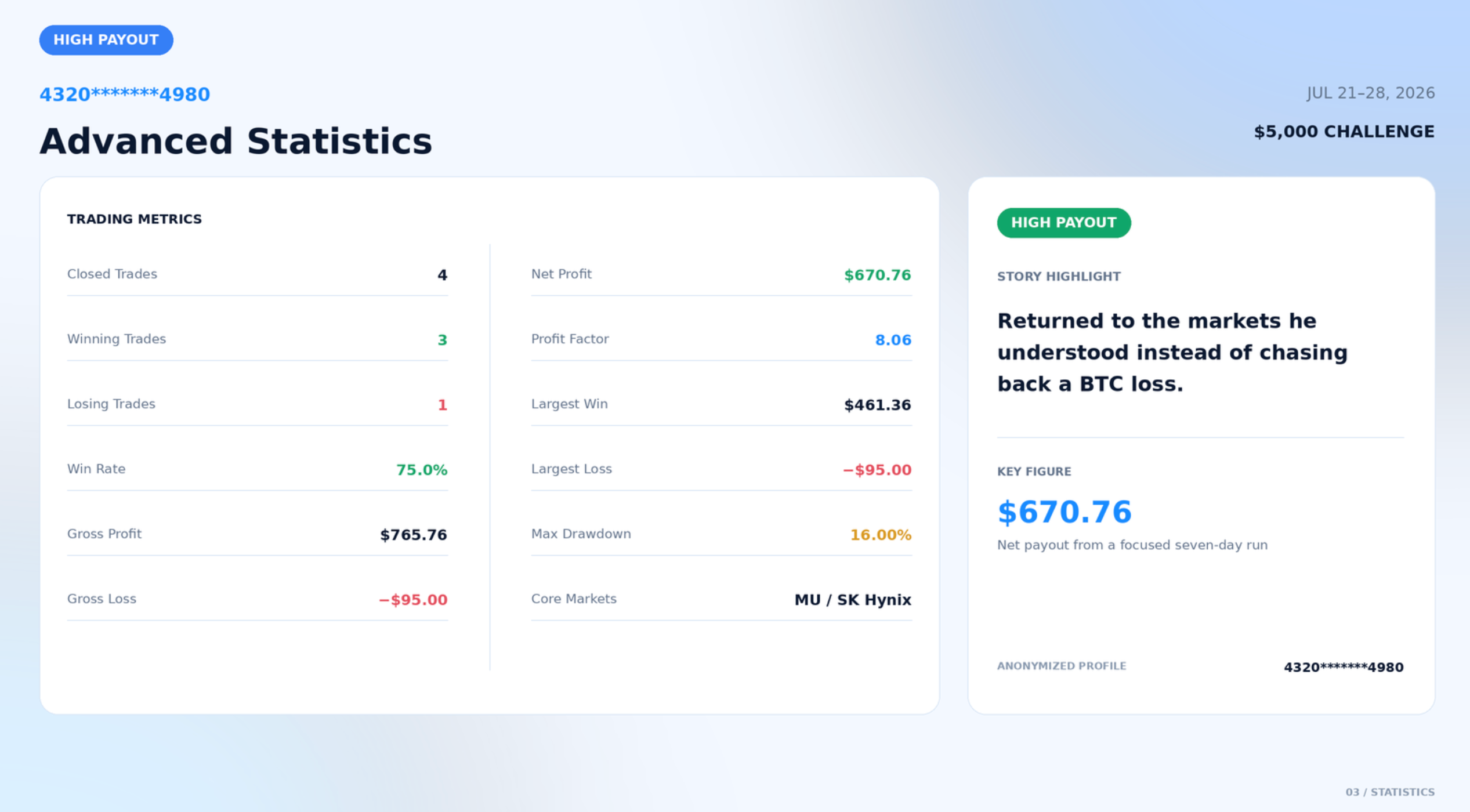
Four positions. Three profitable. One loss. Net profit 670.76 USDC (+13.42%).
 AiXFundedAiXFunded Official Team
 5 min read
 9 views

Key Takeaways
- The trader experienced a 16% drawdown during the challenge.
- He lost $95 in a Bitcoin trade.
- He decided to only trade markets he understands.
- He made a profit of 461 USDC in a SK Hynix trade.
- He achieved a 13.42% return from July 21 to 28.
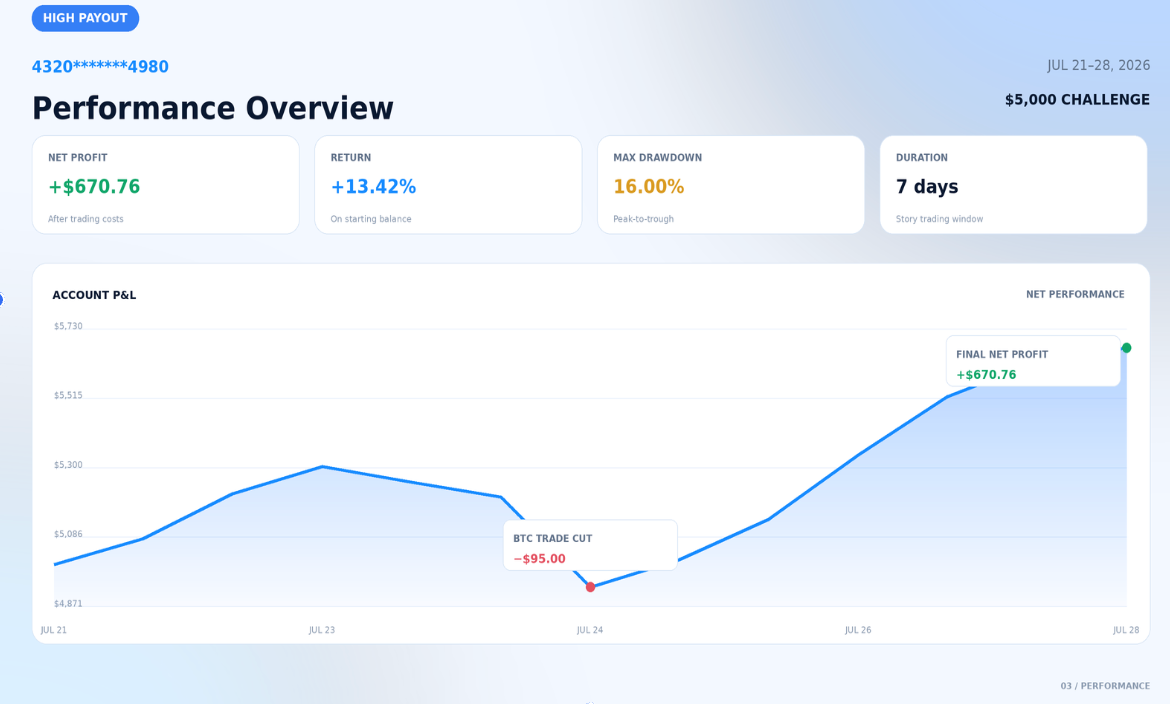
These are the main numbers. But when this trader reviewed his July challenge, he started with the trades he wished he hadn't made.
"That Bitcoin trade cost me $95," he said, "It was the most useful thing for me in July."
He works in hardware procurement. Memory modules pass over his desk daily, along with vendor updates, price increase notices, and conversations about upcoming orders. This gives him a reason to focus on memory-related companies and a practical understanding of the business behind the charts.
This also gave him a rule for this attempt: only trade what he truly understands.
He had failed twice before. The first attempt ended in a drawdown. In the second, he got close to the target, increased position size, and ended up giving back the gains.
This time, he wanted to see if he could stick to his limits.
Starting from familiar territory
He discovered AiXFunded through a trading group. Someone posted an account screenshot along with their experience, and he clicked in.
The first position in this run was shorting Micron. With bullish headlines flooding his feed, he felt a lot of good news was already priced in.
He entered at 975.2, using 2x leverage, and closed the next morning at 941, earning about 340 USDC.
It was a profitable start built around a market he tracked through work. Then, on July 24, he stepped out of this market.
Seventeen minutes of Bitcoin
That afternoon, while watching intraday charts, a Bitcoin setup caught his attention. He went long at 64,200, using 5x leverage.
"The moment it executed, I regretted it," he said. "I never followed the rhythm of that market. It was purely an itchy finger."
Seventeen minutes later, he closed at a loss of about 95 USDC.
This would be the only losing trade out of four. The amount was manageable. The temptation it brought was more familiar—and more unsettling.
He considered opening a larger Bitcoin position to make up for the loss.
He had been through it before: one decision creating pressure for another, position size becoming a way to escape the frustration of mistakes.
This time, he didn't make the next trade.
Close all button
This run also included a reported 16% drawdown. Watching the equity curve slide, he almost gave up on this attempt.
"I really wanted to close everything and pretend I never entered. My finger was on the button."
He didn't describe this moment as an example of perfect discipline.
"What stops me isn't noble either—I don't want to admit I lost to an itchy hand in the same place twice."
For him, the useful decision was to stop improvising. Holding a drawdown wasn't something he wanted to celebrate. Breaking the pattern of chasing losses was.
Returning to what he knew
His next major position was in SK Hynix, a company related to the industry he worked in daily. His perspective was based on supplier conversations and order trends he tracked through work.
He went long at a price of 1,177.5, returning to 2x leverage.
Then he went back to work.
"Those two days I worked normally—checked before leaving, checked before bed, didn't care in between."
By the morning of July 26, the position showed a gain of about 461 USDC.
The difference in his daily life was important to him. For Bitcoin, he was constantly watching short-term fluctuations and reacting to a setup he barely understood. For SK Hynix, he had a reason for the position before opening the chart.
Knowing when to end
On July 28, he made a final small trade in SK Hynix, using about $160 of remaining margin. Three minutes later, he closed the position for a few cents.
His explanation was personal rather than strategic.
"I wanted to see if my hand was still steady—if I wanted to scale up again. It turned out I didn't. So it was time to stop."
In the trading window from July 21 to 28, he completed four positions, three winners and a net profit 670.76 USDC, a 13.42% return.
He said his later payment arrived within half a day.
"I submitted it, went to lunch, and when I came back it was already there—so I actually went to double-check if I had entered the correct address."
But what he kept recalling wasn't the payment part.
Looking back, he remembered losing $95 on Bitcoin that afternoon and considering increasing the position to make up for the loss. He remembered deciding not to do so.
"One of those four was something I clearly got wrong," he said, "I didn't want to delete that part."
His work gave him a reason to focus on memory companies. It didn't give him an understanding of Bitcoin's intraday fluctuations. This challenge made that boundary harder to ignore.
Winning trades produced results. Losing trades gave him some concrete changes.