Most of My Trades Went Nowhere. One ETH Position Changed the Result.
How I completed my AiXFunded 25K challenge—and why I’m careful about what I take away from it.
 AiXFundedAiXFunded Official Team
 4 min read
 14 views

Contents
Key Takeaways
- One ETH position significantly impacted my AiXFunded 25K challenge result.
- Most trades were slightly negative; ETH position drove 10.10% return.
- Avoiding drawdown breaches was crucial during the challenge.
- ETH position was built with 5× leverage and multiple entries.
- Trading less was difficult but necessary to manage drawdown.
Most of My Trades Went Nowhere. One ETH Position Changed the Result.
How I completed my AiXFunded 25K challenge—and why I’m careful about what I take away from it.
I’ve been in crypto since 2016. These days, I spend a lot of my time creating content, hosting live streams, and running a community. Trading has to fit around that schedule.
That’s why I mostly use one-hour charts, a moving average, and volume. I need an approach I can follow without watching every candle. If a setup requires my attention all day, it probably doesn’t fit the way I work.
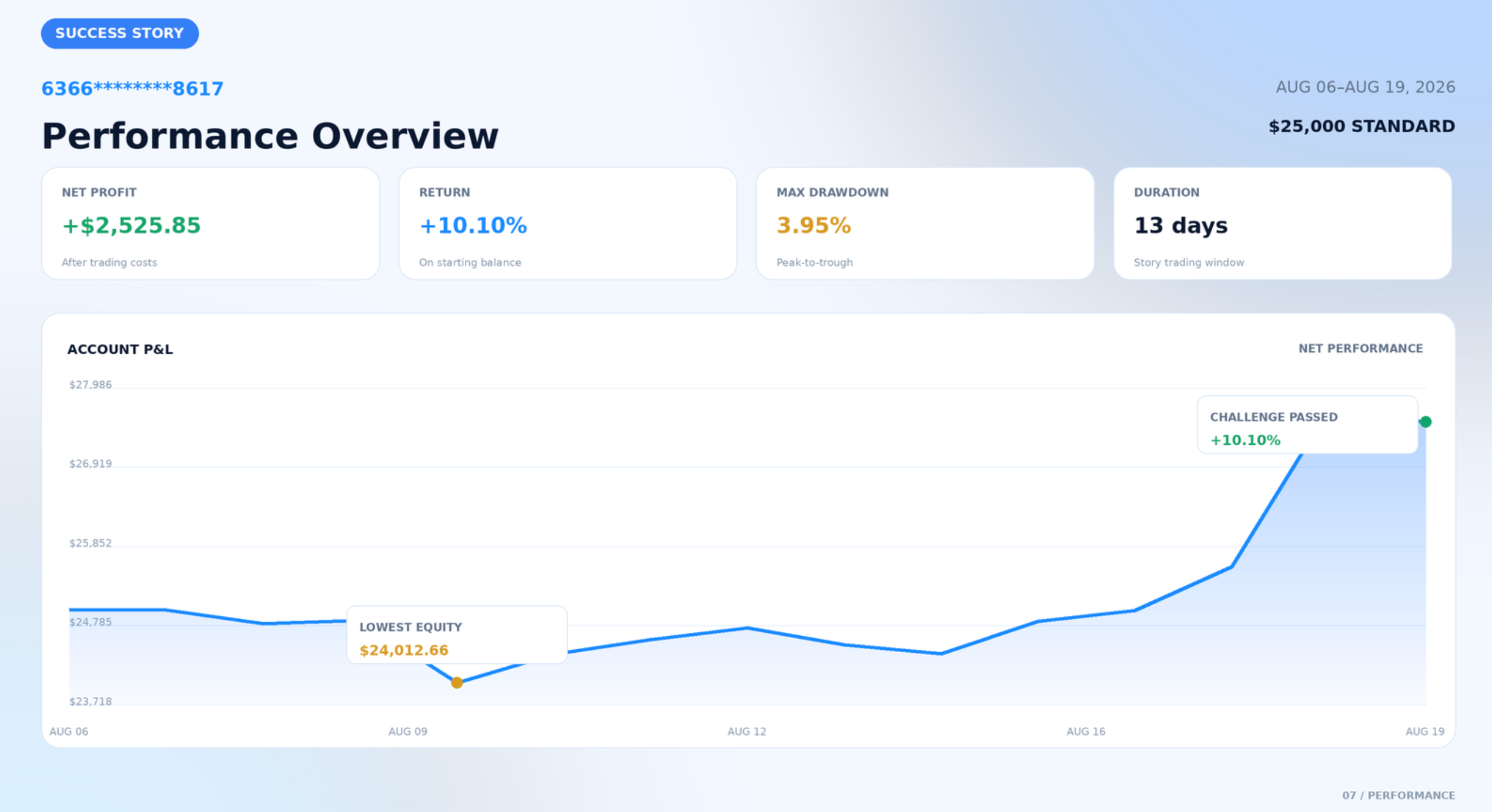
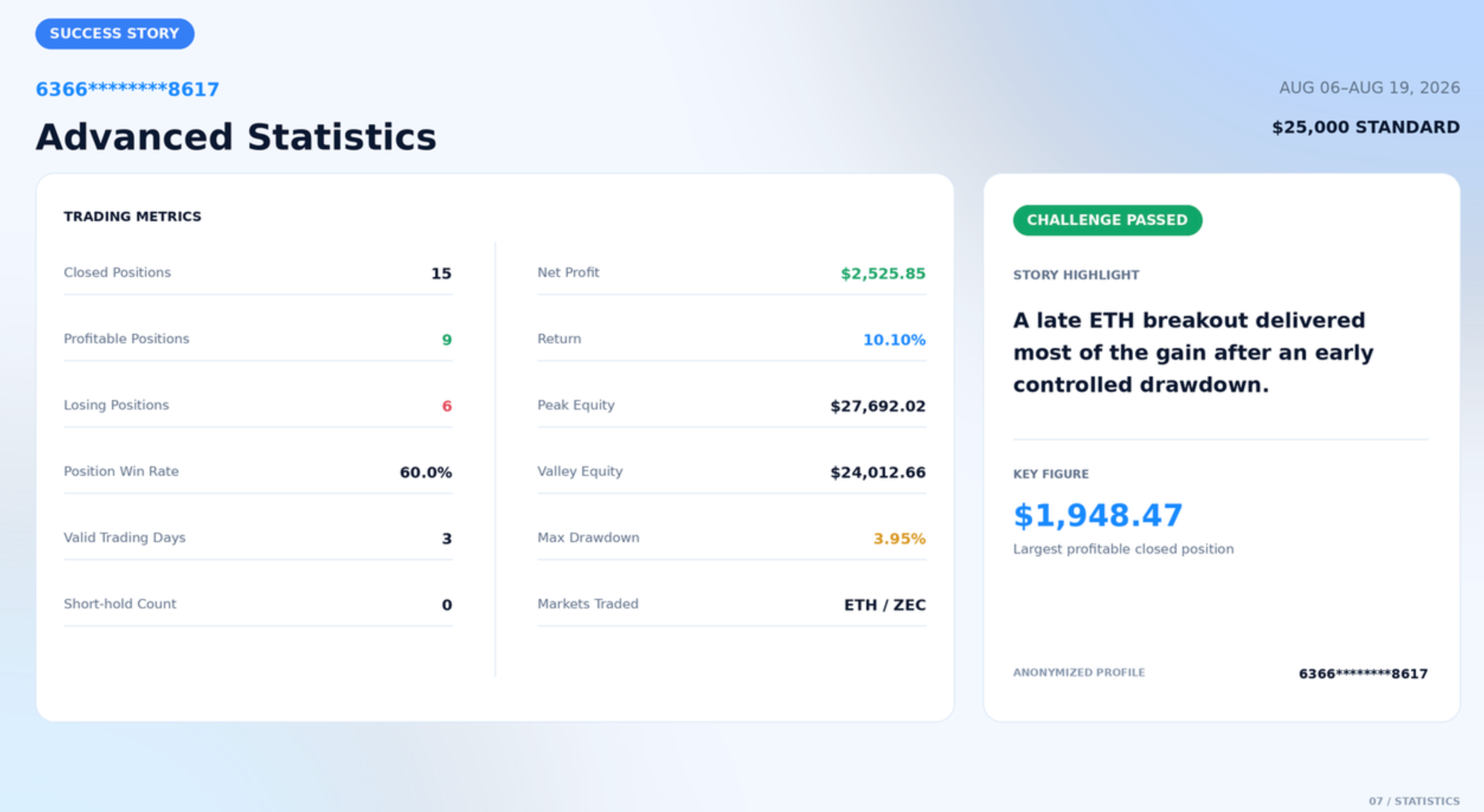
I started my AiXFunded Standard 25K challenge on 6 August. By 19 August, the account had made 2,525.85 USDC, a 10.10% return.
But the result looks much cleaner than the experience felt. Almost all that profit came from one ETH position. Before it closed, my other completed trades were slightly negative overall.
I Had Made This Mistake Before
I first heard about AiXFunded through a group chat. I didn’t join immediately. I looked for payout records, then read the rules, especially the drawdown conditions.
I’d tried several evaluations before and passed some of them. My recurring problem was giving too much back. At other firms, I’d taken profitable accounts into a drawdown breach because I got greedy on another trade.
Going into this challenge, I wanted to avoid repeating that mistake.
By day three, I was already uncomfortably close.
On 9 August, my account was down to 24,012.66, a drawdown of approximately 3.95%. I’d received an alert after crossing the 3% warning level.
The number that mattered to me was the remaining loss allowance. I’d started with $1,500 of room and had already used around $987. After only a few days, roughly two-thirds of that room was gone.
Slowing Down Was Difficult
My first response was to reduce my size and trade less.
Between the 10th and the 12th, I barely traded. I took two small ETH losses while waiting for a clearer direction.
When an account is down, doing very little can feel uncomfortable. You keep looking at the balance and thinking about the distance back to the starting point. I’d been in that situation before, and I knew how easily it could affect my next decision.
Even so, I didn’t stay patient throughout the entire challenge.
On the 17th and 18th, I became more active in ZEC. I thought its price movement would give me opportunities to recover some ground, so I kept taking trades and switching direction.
I ended up with nine trades that made just $35.80 combined. The largest winner was around $433; the largest loser was approximately $458.
That was a lot of activity for very little progress. More importantly, the losing trade was large relative to the allowance I had left. Looking back, that was the part of the challenge where my execution was least disciplined.
Building the ETH Position
Over several days, I also built an ETH long through multiple entries. The final position was 25 ETH, with an average entry of 1,909.02, using 5× leverage.
I prefer entering in stages because it gives me opportunities to reassess before adding more exposure. But I don’t want to make that sound safer than it was. Several entries can still build into one large position, and that is what happened here.
By the time the position was fully built, I had limited room left for losses. I was relying heavily on ETH holding up and moving higher.
ETH had spent much of the preceding week around 1,880 to 1,913. If the market moved against me, I would have to close. There wasn’t enough allowance left to sit through a large adverse move.
I understood that I was committing much of the remaining room to one direction. If it worked, the account could reach