Two Orders, One Risk Budget: Maya’s Lite Challenge
Why cancelling a second crypto order gave her account room to keep trading
 AiXFundedAiXFunded Official Team
 3 min read
 0 views
Contents
Key Takeaways
- Maya's Lite Challenge involved managing a $1,000 account.
- Her BTC trade lost $9, reducing the balance to $982.
- She exceeded Lite’s 12% profit target with a $1,123 balance.
- Maya learned to calculate risks of overlapping orders.
Consider Maya’s Lite challenge. Her first stop-loss reduced a $1,000 starting balance to $991. When she next opened the charts, BTC and ETH were both rebounding from a sell-off. She placed the BTC buy order at a level marked the night before, then added an ETH order as it rose.
Neither order had filled. She planned to keep whichever filled first and cancel the other. Her journal exposed the gap in that plan: both could fill before she clicked cancel.
Two orders could fail together
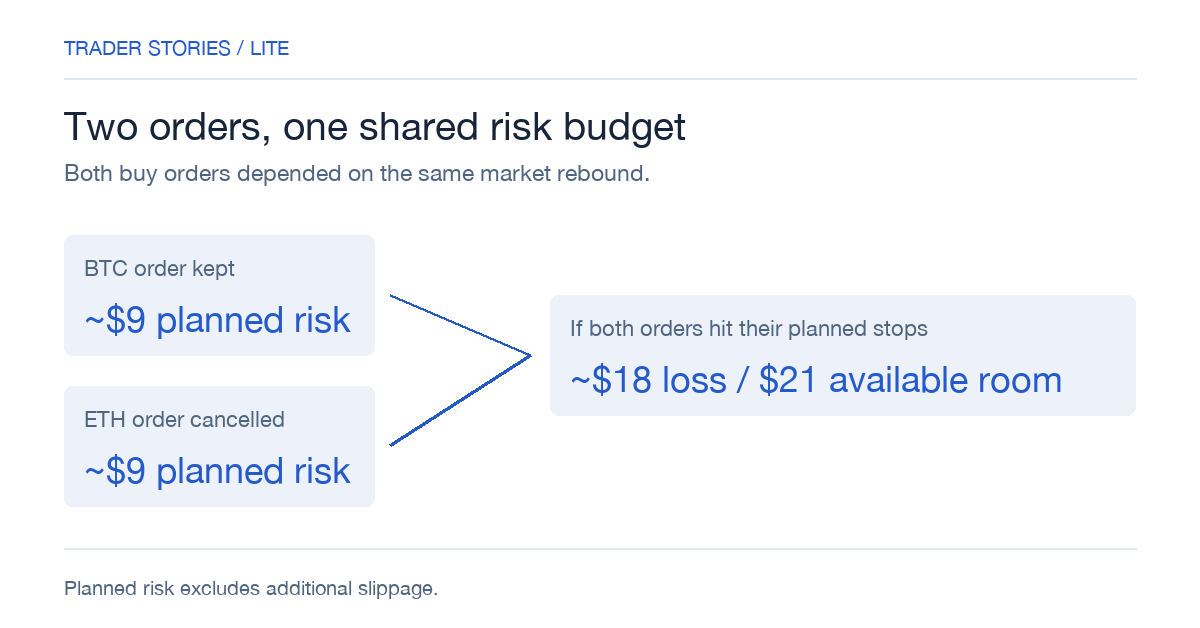
Each order carried about $9 of planned risk. Together, that was about $18 before any additional slippage. Both depended on the same rebound. With $991 left, her account was only $21 above the $970 overall loss threshold. Two planned stops would leave roughly $3 of room.
Lite uses a $1,000 simulated account and a 3% maximum overall loss limit, including unrealised losses. Maya kept BTC because its invalidation level was already documented. ETH had been added simply because it was rising too. She cancelled ETH and added a shared invalidation condition to her journal.
The trade she kept still lost
BTC filled, the rebound failed, and her planned stop closed the position. After trading fees, the loss was $9 and the balance was $982. She did not replace the cancelled ETH order after that stop. The rebound behind both ideas had failed.
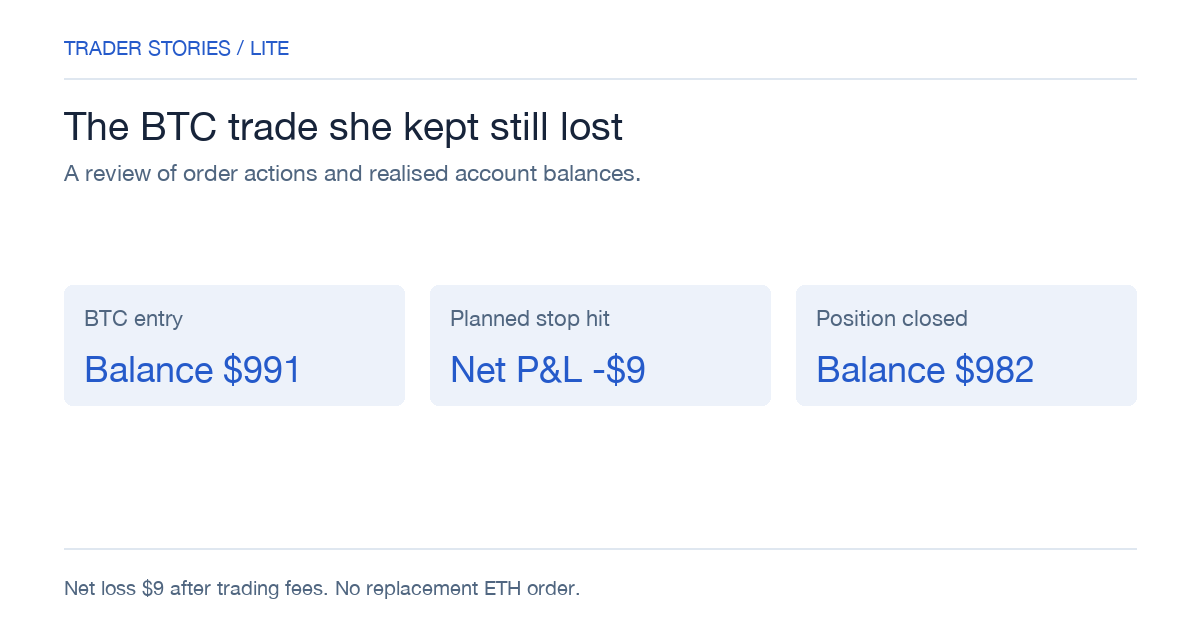
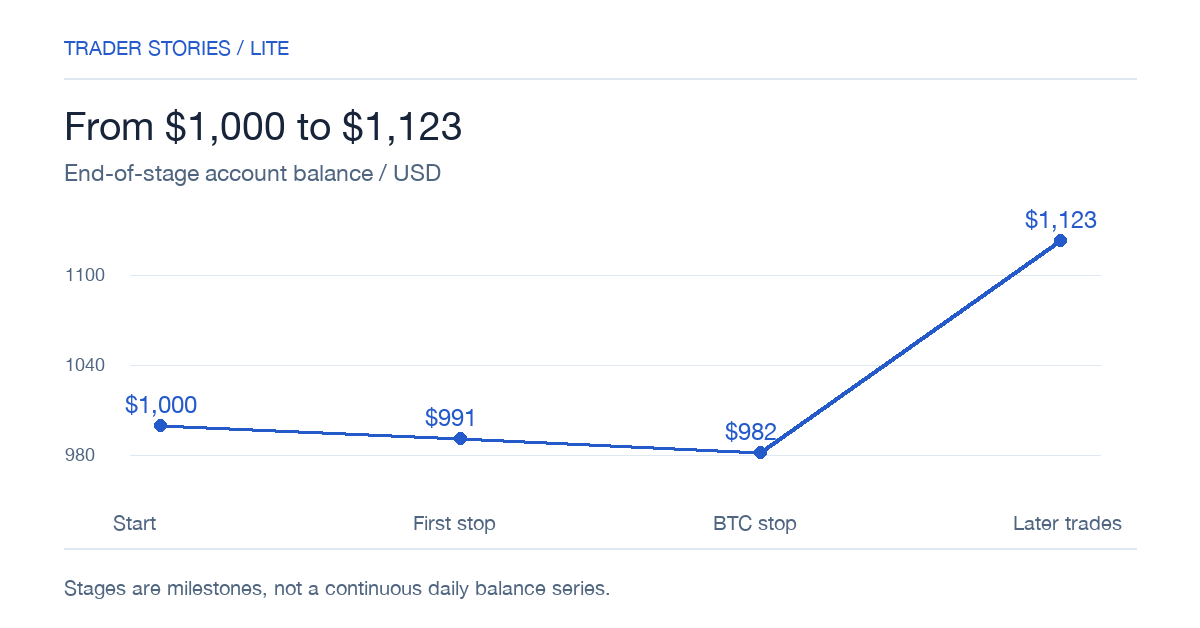
She now had $12 of room above the overall loss threshold. On later trading days, she checked what would happen if overlapping orders failed together. Subsequent trades included wins and losses and added $141 net, taking the balance to $1,123.
| Stage | Net P&L | Balance |
|---|---|---|
| First trade | -$9 | $991 |
| BTC stop | -$9 | $982 |
| Subsequent trades | +$141 | $1,123 |
What the final balance meant
With no open positions at evaluation, $1,123 exceeded Lite’s 12% profit target. The account’s $123 net profit and Lite’s fixed $50 reward have different purposes. The reward requires eligibility and approval. A platform balance withdrawal also has separate conditions, including a 100 USDT minimum.
Looking back, Maya placed the two stop-loss records beside her cancelled order. They explained why her remaining room had once fallen to $12. Before adding another order next time, she would calculate the cost of both being wrong together.
This scenario illustrates a trading decision and the applicable product rules. It does not report a verified customer payout.
Recommended reading

Black Friday: 40% Off & 100% Profit Split on Your First Payout
Our Black Friday sale starts November 19. Use your Black Friday coupon to get 40% off any Standard or Boost Challenge. Once that account meets the payout requirements, you’ll keep 100% of the eligible profits on its first payout.

AiXFunded Community Invite Competition: Every 3 Invites = 1 Lucky Draw, Win Up to a $15,000 Challenge!
Join AiXFunded's Invite Competition to win up to a $15,000 Challenge by inviting friends.

Who is the next Oracle? Guess the BTC price and win a $5,000 AiXFunded Challenge!
Predict BTC price weekly with AiXFunded for a chance to win a $5K Standard Challenge account.